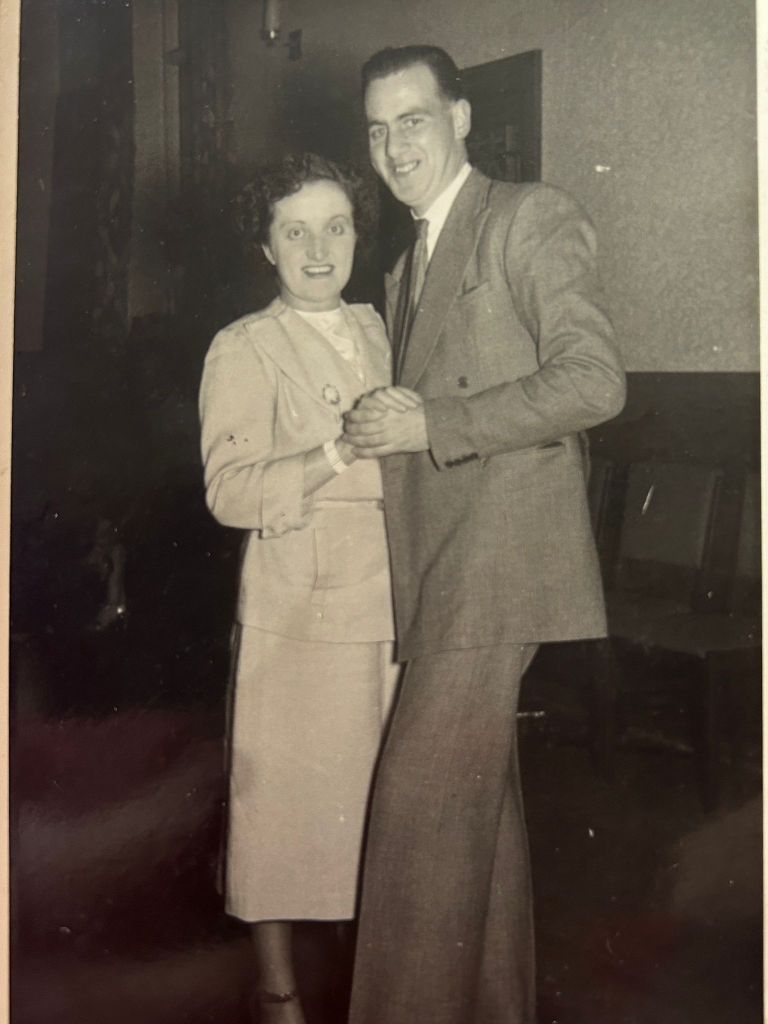
First published in Tears in the Fence, Issue 82, The Record Keeps Skipping is a poem about my Irish inheritance, and about trying to make visible what gets passed down when so much of it comes through gaps, silences and damaged records.
Irish migrants were among those who helped physically make post-war Birmingham, on its roads and building sites, in factories, transport and hospitals. Our public memory has tended to hold that history through community archives. Traditional Irish culture sits comfortably alongside this Birmingham-Irish archive, because the music, dancing and festivals offer a visible line of continuity. And that recognisability is classed too. Working-class Irish culture is not only easy to see and name, but is often framed as nostalgic or kitsch rather than intellectually serious. Irish Birmingham has very much produced literature; what feels less developed is the framing of that writing as our continuing diasporic tradition.
My paternal grandparents, Rita and Denis, were born in Dublin and moved to Birmingham twenty-five years before I was born. But here in Birmingham with its massive post-war Irish migration, my proximity to their Irishness slides surprisingly quickly into a kind of not really Irish-ness: too English, too far removed, not enough of the right evidence. Their lives are still in our living family memory, but my inheritance of their Irish identities can feel as though it needs to be proved. The shadow of the 1974 pub bombings, around a year before my birth, sits inside this history too as Birmingham-Irish identity became bound up with caution, assimilation and silence. This was part of the atmosphere in which my own inheritance has been carried.
That can leave my Irishness feeling a like a ghost in the shell. It is there in family memory, silences and connections, but not in forms that read as recognisably Irish to other people. Even my Irish surname arrived in an anglicised form, carrying its own history of forced adaptation. The inheritance is present without being intact.
For second and third generations, Irishness becomes mixed into the wider life of Birmingham, across other diasporic identities, becoming hybrid and sometimes seemingly contradictory. This isn’t particular to the Irish diaspora. Across Birmingham, later generations in many migrant communities are living with the same questions of continuity, mixture and cultural legibility. I don’t think the answer is to work backwards towards a more recognisable version of the culture we inherited, or to prove ourselves through traditional forms. The ghost is part of the inheritance too.
And so I am not interested in recovering a coherent Irish Birmingham. I am interested in family voices, myths and objects. Transmission changes things. The historical and the intimate refuse to stay in separate boxes, and incompleteness becomes part of the subject itself. That is the tension underneath The Record Keeps Skipping: not how to repair the archive, but how to write from what is partial, misremembered or missing.
There is something tragic in my diasporic inheritance, and I don’t mean tragic because it has failed to remain ‘properly’ Irish. Mine is an inheritance shaped by migration, class, assimilation, political suspicion, family silence and all the ordinary losses that happen between generations.I don’t need to tidy it into something recognisably authentic.
I also want to keep taking material that is easily dismissed as working-class “heritage” and refuse the implied smallness. This is not lesser material because it arrives through photo albums and family lore. I do not have to solve my cultural identity before it can become art.
The ghost is an archive, and one that can never be complete.
It is a place from which poetry can begin.
The Record Keeps Skipping
an archive of Anglo-Irish descent
(i) Shoebox marked: RELIGIOUS / PERSONAL
– a rosary, short three beads
– final payslip from Birmingham Transport
– misc. mass cards, silver-tone faces
– note folded into the tin:
keep these for Claire
– photographs:
crease through one baby,
the other blurred
(ii) Cassette tape: HOME RECORDING / 1974
Audio faint.
Overdubbed in places.
– they bombed it again
– shave your vowels
– don’t say your name
Click.
Static.
Irish Sea.
Nothing.
(iii) File marked: HEALTH / MENTAL
Handwritten:
– hospitalised a year
– lives alone
– fears arrest for her accent
File won’t close.
Last page is missing.
(iv) Box: DOMESTIC / UNSORTED
– slacks, rolled
– schoolbook: paddy rubbed from the margin
– clipping:
Six Guilty in Bomb Trial
– pencilled inside the lid:
no ocean in Nan’s lounge
her toes tread carpet
(v) Exhibit: INSTALLATION / SIDE ROOM
Trip hazards ahead.
Some viewers may find this disturbing.
Footage:
– woman with no key
– man in RAF blues, lighting a Woodbine
– number 11 bus pulling in
– net curtain lifted, then dropped
– a door slammed
No voiceover.
No narration.
(vi) Loose note: MISC. DOMESTIC
– see what murder you lot have done now
Loop of the d matches my dad’s.
(vii) Label: MEMORY WHEEL / PARTIAL
A – alone: she left with no claim
B – bus doors hissing shut at Small Heath
C – Catholic, but English now, aren’t we?
Stuck on D.
Label scratched off.
Just the corner of a word.
(viii) Wall Chart: RULE / IMPACT
– famine
– execution
– enlistment
– migration
– sectarianism
– fatal heart attack, fifty-two
– widow’s breakdown
One arrow loops back
to the hallway.
Shoes on—
he’s still pacing.
(ix) Retaped Box. No Label on File.
Something shifts when handled.
Stamped:
Archive Incomplete/ Index Corrupted
First published in Tears in the Fence, Issue 82,

